
Greenhead Flies in Massachusetts: What They Are, Where They Strike, and How to Protect Yourself
Every summer, beachgoers across Massachusetts learn the hard way that the ocean isn’t the only thing ready to bite them. Greenhead flies — aggressive, persistent, and seemingly impervious to swatting — are one of the most notorious seasonal nuisances along the Massachusetts coast. If you’re spending time near the water from June through August, here’s everything you need to know.
What Are Greenhead Flies?
Greenhead flies are a type of horsefly belonging to the family Tabanidae. The name comes from their most distinctive feature: large, iridescent compound eyes that appear dark green. They’re hard to miss — and once they’ve found you, they’re even harder to shake.
Technically, “greenhead” refers to two related species — Tabanus nigrovittatus and Tabanus conterminous — both found along the Atlantic Coast from Nova Scotia all the way down to Florida. In Massachusetts, they’re a fixture of coastal summer life.
Where Do Greenheads Come From?
Greenheads are a product of the salt marsh ecosystem. Their entire lifecycle plays out on and around coastal marshes:
- Eggs are laid on salt marsh grass (Spartina spp.), typically in masses of 100 to 200 eggs per female — and a single female can lay up to four egg masses over her lifetime.
- Larvae hatch and burrow into the marsh, where they live for one to two years, feeding on other invertebrates — including their own kind. Research has documented as many as 70–80 larvae per square yard of marsh sod.
- Pupation occurs at the marsh surface in early summer, followed by adult emergence roughly 10 days later.
- Adults mate on the open marsh. Males feed on nectar-like substances. Females go hunting for blood.
Only female greenheads bite. They need blood to develop their next egg mass — for the same biological reason female mosquitoes require blood. Protein from the larval stage fuels the first egg mass; every subsequent one requires a blood meal. That’s the engine driving all that aggressive behavior on the beach.
Adult females live three to four weeks in upland areas near the marsh, steadily building up in numbers as new flies emerge. That accumulation is part of what makes peak season so intense.
When and Where Are Greenheads Worst in Massachusetts?
Greenhead season in Massachusetts runs June through September, with peak activity typically falling in the last two weeks of July and the first week of August. The farther south along the coast, the earlier the season peaks.
Females are most active from 10:00 AM to dusk. They’re attracted to large, dark objects, carbon dioxide, movement, and body heat — which means a crowded summer beach is essentially an ideal hunting ground.
Cape Cod
On Cape Cod, adult flies are most abundant from July through mid-August. The extensive salt marsh habitat of the Cape supports large greenhead populations each summer. The Cape Cod Greenhead Fly Control District (CCGCD) — established in 1945 and funded by all Barnstable County towns — manages trapping efforts across the region.
North Shore / Essex County
The Great Marsh in Essex County — one of the largest salt marshes in the northeastern United States — produces some of Massachusetts’ most intense greenhead activity. Notoriously affected beaches include:
- Crane Beach, Ipswich
- Plum Island Beach, Newburyport
- Wingaersheek Beach, Gloucester
The Northeast Massachusetts Mosquito Control and Wetlands Management District deploys over 400 box traps on Essex County marshes each year, capturing millions of flies over the course of the season.
South Shore
Coastal communities on the South Shore see greenhead pressure wherever salt marsh habitat exists, particularly near tidal areas in towns like Marshfield, Duxbury, and Plymouth.
Why Do Greenhead Bites Hurt So Much?
Unlike mosquitoes, which use a needle-like proboscis to draw blood with minimal initial sensation, greenheads have cutting mouthparts designed to slice through skin. When a female bites, she injects saliva containing an anticoagulant that prevents your blood from clotting. The pain is your body’s reaction to that foreign chemical. The welt that follows is an ongoing allergic response to the saliva — similar in mechanism to a mosquito bite, but more aggressive and considerably more painful.
The good news: greenhead flies are not known to transmit disease to humans. They are a nuisance and a source of real discomfort, but they pose no documented public health risk comparable to mosquitoes.
That said, some individuals experience strong allergic reactions to greenhead bites. Anyone with a history of insect-related allergies should take appropriate precautions.
How to Protect Yourself from Greenheads
Prevention is your best tool. Here’s what actually works:
Clothing and timing:
- Wear light-colored clothing — greenheads are strongly attracted to dark objects
- Opt for long sleeves when near marsh areas
- Dry off quickly after swimming — wet skin combined with dark swimwear is a target combination
- Avoid peak hours: females are most active from 10:00 AM to dusk
Scent and behavior:
- Avoid perfumes and heavy scents — these attract biting flies, as does increased metabolic activity
- Aerosol repellents have limited effectiveness against greenheads compared to mosquitoes
At home and on your property:
- Screen in pools, porches, and patios
- Keep car windows closed near marsh areas — a greenhead inside a moving vehicle is a genuine distraction hazard
How Are Greenheads Controlled? The Box Trap Story
Controlling greenheads at scale is genuinely difficult. They breed across vast stretches of ecologically protected salt marsh, making pesticide application neither practical nor environmentally appropriate. Burning marshes, ditching, and water management have all been tried and found ineffective — and in some cases, ditching can actually enhance greenhead larval habitat.
The primary — and most effective — control method is the box trap, a deceptively simple device developed originally by researchers at Rutgers University and refined over decades of use by Massachusetts mosquito control districts.
How the Box Trap Works
The trap exploits a greenhead’s own biology against it. Females seeking a blood meal are strongly attracted to large, dark, heat-absorbing objects — simulating the silhouette of a large animal. The box trap is painted blue on the outside (research has shown blue to be the most attractive color to blood-seeking greenheads) and flat gray on the inside. It sits on legs with its open bottom approximately two feet above the marsh surface — the altitude at which greenheads typically fly.
Flies approach from below, enter the open bottom, and instinctively move upward toward light. They pass through screen cones at the top corners of the box and into sealed collectors, from which they cannot escape. Trapped flies typically die within 24 hours.
A single well-placed trap can capture up to 30,000 flies by the end of a summer season.
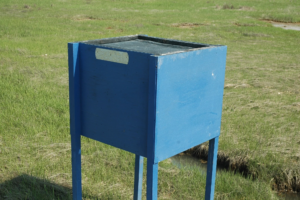
A blue box trap deployed on a Cape Cod salt marsh. Photo: Historical Society of Old Yarmouth
Octenol: Artificial Ox-Breath
In 1992, the Cape Cod Greenhead Fly Control District — with funding from the Kelley Foundation — tested scent bait additives in the traps. Earlier research on tsetse flies and mosquitoes had shown attraction to octenol, a compound sometimes called “artificial ox-breath” that mimics the scent of large mammals. The results were striking: adding octenol to the traps attracted up to three times as many flies compared to unbaited traps. Today, roughly half of Cape Cod’s traps are baited with octenol each season.
Trap Placement
Placement is critical to effectiveness. Traps are positioned on the salt marsh — 50 to 100 feet out from the upland edge, spaced approximately 200 feet apart along the marsh perimeter. Marsh placement outperforms upland placement because it intercepts flies before they disperse toward populated beaches and properties. Traps placed in yards are less effective because they compete with structures and vegetation for the flies’ visual attention.
On Cape Cod, the CCGCD recommends installing traps from June 15 through September 15. In Essex County, the Northeast Massachusetts Mosquito Control District deploys over 400 traps annually. The CCGCD in Barnstable County runs more than 800 traps across the region.
Greenheads and Your Mosquito Control Service
If you’re already on a mosquito control program with Greenhow, it’s worth understanding where greenhead management fits in. Mosquito barrier sprays and larvicide treatments target Culicidae — a completely different insect family. Standard mosquito treatments don’t address greenheads.
What does help on your property: reducing dark, moist areas near the marsh edge; physical screening; and awareness of your proximity to salt marsh habitat. Properties directly adjacent to coastal marshes will always face some greenhead pressure during peak season. No residential treatment will fully eliminate that — but understanding the biology and using the right precautions makes a real difference.
Questions about what’s feasible for your specific property and location? Contact our team — we’re happy to walk through the options.
The Bottom Line
Greenhead flies are a real part of summer life on the Massachusetts coast. They’re painful, persistent, and built for exactly the kind of environment our beaches offer. Understanding their biology — where they come from, when they peak, and what actually deters them — is the best preparation for a season with fewer miserable moments on the sand.
Greenhow Inc. provides pest control and mosquito and tick management services across the Greater Boston Area, the South Shore, and Cape Cod. Questions about protecting your property this summer? Get in touch with us here.
Sources: Cape Cod Greenhead Fly Control District pamphlet (CCGCD, Yarmouth Port MA); Cape Cod Mosquito Control Project (ccmcp.net); Northeast Massachusetts Mosquito Control and Wetlands Management District (nemassmosquito.org); “The Greenhead and You,” Elton Hansens and Stuart Race, Rutgers University Department of Entomology; WBUR News, “Greenhead flies are back and out for blood in Mass.” (July 4, 2025); HSOY.org blog post “Cape Cod Salt Marshes – asset or swamp? — Historical Society of Old Yarmouth“